
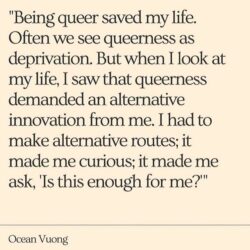
“Being Queer saved my life. Often we see queerness as deprivation. But when I look at my life, I saw that Queerness demanded an alternative innovation from me. I had to make alternative routes; it made me curious; it made me ask, Is this enough for me?”
— Ocean Vuong
June is Pride Month, and as summer invites us outdoors, into community, and into reflection, I find myself thinking deeply about identity—not only who we are, but the stories we inherit about who we are supposed to be.
As a queer Asian person, Pride often feels more nuanced than celebration alone. It is also an invitation to reflect on the histories, wounds, resilience, and wisdom that live within our communities and our bodies. When I consider the histories of both queer and Asian communities, I notice striking parallels in the ways our nervous systems have been shaped by larger cultural narratives.
For queer communities, dominant narratives have often centered around immorality, sickness, and deviance. For Asian communities, narratives have frequently revolved around foreignness, exploitation, labor, and perpetual outsider status. Different stories, different histories—but both leave traces on the body. Both create questions about belonging and exile, acceptance and rejection, visibility and safety.
Many of us spend years trying to become “enough” in a world that has repeatedly suggested otherwise.
This is why Ocean Vuong’s words resonate so deeply with me. Rather than viewing identity as a limitation, he describes queerness as an invitation toward creativity, curiosity, and alternative possibilities. The need to forge new paths can become a source of strength. The very experiences that once felt isolating can become the foundation for wisdom, community, and transformation.
This month, I invite you to consider the meta-narratives that surround the communities to which you belong. What stories have you inherited about your race, gender, sexuality, body, family, class, faith, or culture? Which of those stories have shaped your nervous system? Which have taught you to contract, hide, perform, or protect yourself? And which stories are ready to be released?
Our bodies carry memory—not only our own, but often echoes of generations before us. Mental health work gives us an opportunity to gently examine those memories and ask what still serves us. It helps us recognize the survival strategies that once protected us while creating space for new ways of living, connecting, and belonging.
Pride is not simply about celebration. It is also about remembrance, healing, resistance, and self-definition. It is about honoring the pain of our journeys while refusing to let pain be the entirety of our story.
As you move through this Pride Month, I encourage you to make contact with both your pain and your pride. Reflect on the resilience that brought you here. Honor the parts of yourself that learned how to survive. And consider what becomes possible when survival is no longer the only goal.
May this month be an opportunity to cultivate greater compassion for yourself, deeper connection with your communities, and renewed pride in the person you have become.
Warmly,
Dr. Noel B. Ramirez, DBH, MPH, LCSW, CSAT, CMAT
Founder & Executive Director
Mango Tree Counseling & Consulting
“Our identities do not merely tell us who we are. They can also teach us new ways of imagining what is possible.”