

Summer has a way of slowing time down—between semesters, vacations, and long, sun-soaked days. And in that slowness, I often find myself reflecting on energy:
How is mine nourished? Cleansed? Depleted? Stolen? Given away—or even disrespected?
While I hold space for the truth that time is a subjective, colonial construct, I also live in a world where I must make choices that honor my livelihood, health, family, and community. And like many of us—especially those in the diaspora—I’ve wrestled with the disconnection between my body and my labor. I might be crushing it at work, but why do I come home numb? Why is my food delivery bill through the roof? Did I really just say I don’t have time to eat, sleep, or love?
A fellow AANHPI therapist, writer, and clinical leader, Israa Nasir, calls this state a “functional freeze.”
It’s the slow numbing many of us experience when productivity becomes survival: watching the same show on loop, ghosting our own hunger cues, running on residual fatigue.
I’ve lived in that freeze—more than once—animated by narratives of resilience handed down from my immigrant, factory-working parents. Ironically, it was they—my first teachers in over-functioning—who once pulled me aside and asked, “Are you burnt out?”
That question landed hard.
Because beneath all my “doing,” I had misplaced my honor—not in my vision, or my joy—but in my role. I romanticized survival and mistook it for a calling.
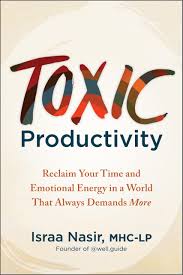
Israa’s work, especially her book Toxic Productivity, deeply resonates because it speaks from within the diaspora. Her words echo what many of us know:
“So many people internalize cultural and familial beliefs that acceptance only comes through productivity.” – Israa Nasir
My parents labored with full hearts in jobs that gave us a simple life. Their gregariousness, rage, exhaustion, and tenderness were all shaped by work. And though they offered cautionary tales, I clung to their model—because I didn’t yet have one of my own.
In times of uncertainty and alienation, I defaulted to a survival narrative. But it was never mine. It was simply the only one I had access to.
Now, I choose to reframe.
I choose intentionality.
And I borrow from James Baldwin, a queer Black ancestor, who reminds us:
“Your crown has already been bought and paid for. All you have to do is put it on your head.”
Even when our presence is questioned, our worth is not.
Our arrival is true.
It is beautiful.
It is glorious.
The only question is: how do we remember that?
As summer winds down, here’s your gentle invitation:
Audit your energy. Ask yourself:
- What does authentic flow look like—for me to show up in all areas of my life?
- Which relationships and connections fuel my spirit and resilience?
- Are the narratives I carry about productivity and worth still serving me?
- How do I restore after I’ve done and given?
- What care rituals need to be protected, not as indulgences—but as acts of sacred restoration?
You deserve a rhythm that honors you.
Let this be the season where you crown yourself again.
Warmly,
Noel
Founder, Mango Tree Counseling & Consulting
www.mangotreecc.com